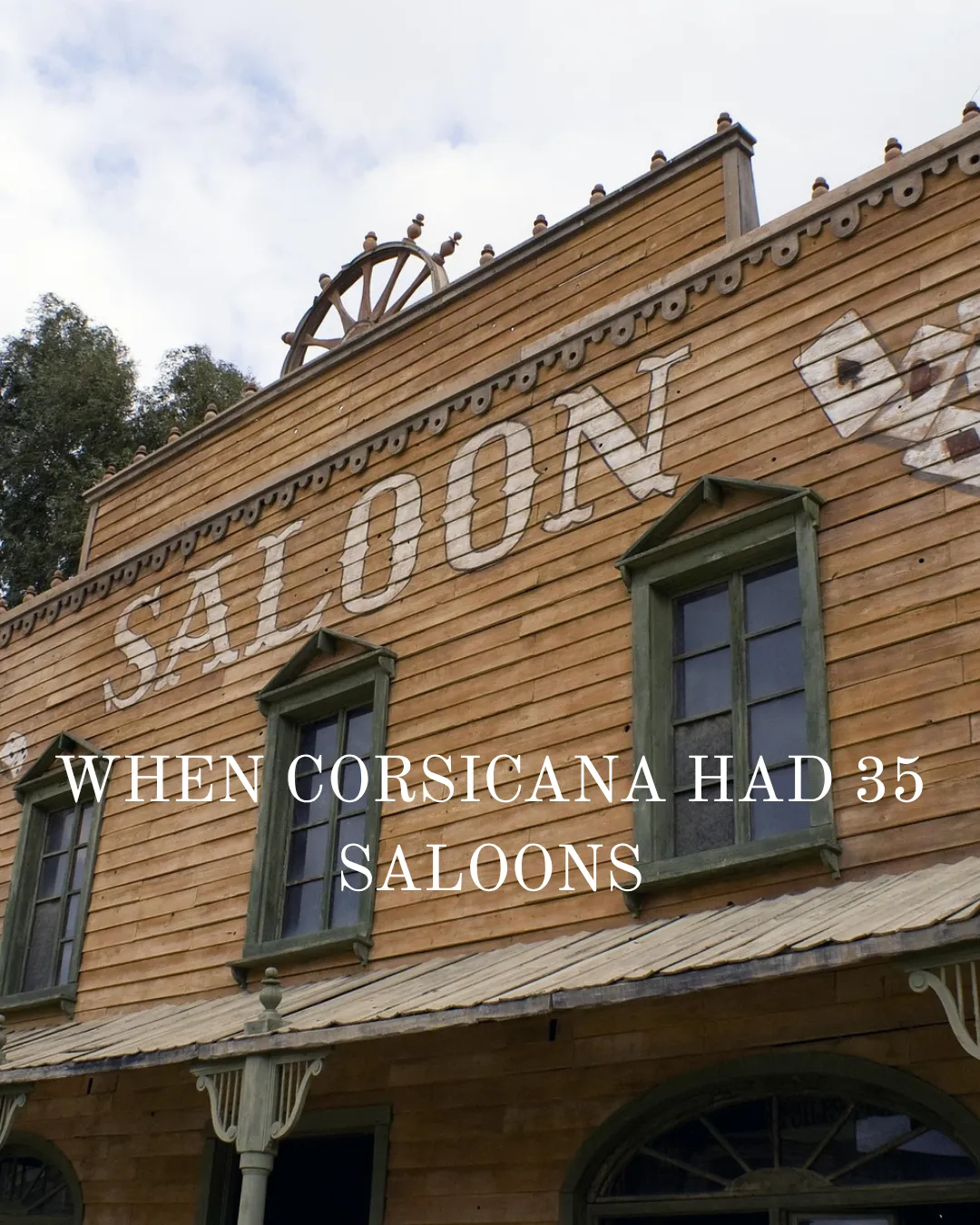
When Corsicana Had 35 Saloons: Oil, Prohibition & a Wild Texas Boomtown
If you think you know Corsicana, picture this version of town:
Oil derricks rising from yards and gardens.
Hotels filled with newcomers.
Newspapers competing for readers.
Oilmen arriving from across the country.
And 35 saloons serving a town of fewer than 10,000 people.
Yes, you read that correctly.
By 1900, Corsicana had 9,313 residents—and 35 saloons.
For a few remarkable years around the turn of the century, Corsicana wasn’t simply a quiet North Texas agricultural town.
It was an oil boomtown.
And things were getting interesting.
It All Started With a Water Well
The story really begins in 1894.
Corsicana was growing rapidly and needed a better water supply, so city leaders organized an effort to drill an artesian well.
Instead of finding the water they were looking for, the drillers hit something else.
Oil.
At first, this wasn’t necessarily considered good news. They were trying to find water, after all.
But people soon realized what lay beneath Corsicana.
Drilling began.
By 1897, dozens of wells were producing. By 1898, hundreds of wells had been completed in the Corsicana field.
Oil derricks began appearing across town—even in residential yards and gardens.
Corsicana had accidentally helped launch the Texas petroleum industry.
And with oil came money.
Then Came the Boom
The discovery transformed Corsicana.
Oilmen and investors arrived from across the country. Drillers and laborers needed places to sleep, eat, and spend their money.
Businesses multiplied.
By 1900, Corsicana had:
Three banks.
Twelve newspapers.
Eight hotels.
Forty-nine retail stores.
A cotton mill.
Thirty-two doctors.
And then there were those 35 saloons.
Just think about that for a minute.
There were more saloons than doctors.
What Did Corsicana Look Like?
It must have been almost unrecognizable compared with the Corsicana we know today.
Wooden oil derricks rose throughout parts of town.
Horse-drawn wagons traveled the streets.
Workers came and went from the oil fields.
Hotels accommodated businessmen and visitors.
And saloons provided gathering places for a rapidly growing population with money in its pockets.
This wasn’t happening somewhere far away in a legendary West Texas oil town.
It was happening right here in Corsicana.
The same community we drive through today was once helping invent an entirely new Texas industry.
Not Everyone Was Thrilled About Those 35 Saloons
As you might imagine, the saloons became a major point of contention.
A growing temperance movement developed among Corsicana residents who believed alcohol and the saloon culture surrounding the boom were creating problems for the community.
Eventually, the movement gained enough support to force change.
In November 1904, local prohibition passed.
Corsicana’s saloons were ordered to close.
After years of boomtown drinking, Corsicana was officially dry.
Problem solved.
Well…
Not exactly.
Enter the Bootleggers
Closing the saloons didn’t mean Corsicana’s oilfield workers suddenly lost their taste for alcohol.
Instead, another business opportunity appeared.
Bootlegging.
Illegal sellers quickly stepped in to meet the demand left behind by the closed saloons.
So while prohibition eliminated the legal saloon business, it certainly didn’t eliminate drinking.
It’s one of those details that makes history feel surprisingly familiar.
Pass a law.
People find a workaround.
Some things apparently haven’t changed much in 120 years.
Meanwhile, Corsicana Was Making Texas History
The saloons are the fun part of this story, but something much bigger was happening at the same time.
Corsicana’s oil industry was becoming incredibly important.
Texas’s early modern refinery operations developed here.
New drilling technology was refined here.
Corsicana-made rotary drilling equipment would later help drill the famous Spindletop gusher near Beaumont in 1901.
And the success of the Corsicana field demonstrated that commercially significant oil production was possible in Texas.
By 1900, the Corsicana field was producing more than 800,000 barrels of oil annually.
The town wasn’t simply benefiting from the Texas oil industry.
Corsicana was helping create it.
And Corsicana Wasn’t Finished Yet
That would be enough oil-boom excitement for one town.
It wasn’t.
More than two decades later, another enormous discovery southeast of Corsicana would trigger the Powell oil boom.
Thousands of people poured into Navarro County.
Tuckertown sprang up almost overnight.
And for a second time, this part of Texas found itself caught up in oil fever.
But that’s another story.
It’s Hard to Picture Today
That’s what I love about learning these little pieces of local history.
We drive down the same streets and pass the same blocks every day without thinking much about what they looked like generations ago.
But imagine standing in Corsicana in 1900.
You might hear drilling equipment in the distance.
See an oil derrick behind someone’s house.
Pick up one of a dozen local newspapers.
Pass a hotel filled with visiting oilmen.
And apparently, you wouldn’t have to walk very far before finding somewhere to get a drink.
Thirty-five saloons in a town of 9,313 people.
Corsicana has changed quite a bit since then.
But underneath the Corsicana we know today is the story of a surprisingly rowdy little Texas oil town that helped change the state forever.
