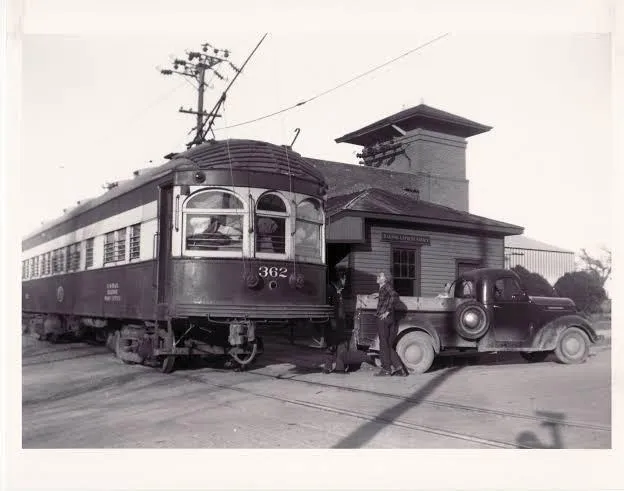
Before I-45: You Could Take an Electric Train from Corsicana to Dallas
Imagine living in Corsicana more than 100 years ago.
You need to go to Dallas.
There’s no I-45. No SUV. No Google Maps telling you there’s a slowdown in Wilmer.
So what do you do?
You take the electric train.
That’s right. Beginning in 1913, Corsicana residents could travel to Dallas aboard an electric interurban railway—and at its busiest, the line offered as many as 12 round trips a day.
It sounds surprisingly modern for something that happened more than a century ago.
What Exactly Was an Interurban?
Think of it as a cross between a streetcar and a commuter train.
Electric interurban railways became popular in the early 1900s as a way to connect cities and smaller communities with frequent passenger service.
Texas embraced them wholeheartedly.
Eventually, the state had nearly 500 miles of electric interurban track, with most of it concentrated around North Texas.
And Corsicana was part of that network.
Dallas to Corsicana — By Electricity
The 56-mile electric railway connecting Dallas and Corsicana was completed in 1913.
The route traveled south from Dallas through communities including Ferris and Ennis before continuing toward Corsicana.
The interurban didn’t just drop passengers somewhere outside town, either.
Once it reached Corsicana, it traveled along city streets.
For residents, this provided a remarkable connection to Dallas at a time when long-distance automobile travel was still relatively new.
And the service was frequent.
At one point, the Texas Electric Interurban Railway operated as many as 12 daily round trips between Dallas and Corsicana.
Imagine having that option today.
Corsicana Was Connected to Something Much Bigger
The Corsicana line eventually became part of the Texas Electric Railway, which operated three major routes out of Dallas:
Dallas to Denison.
Dallas to Waco.
And Dallas through Ennis to Corsicana.
After several railway companies consolidated in 1917, Texas Electric operated more than 200 miles of track and became one of the country's largest interurban systems.
Passengers weren’t the only things moving along the rails.
The railway also carried mail and express shipments, helping connect smaller Texas communities with larger commercial centers.
A Different Kind of Commute
It’s fun to picture what this must have meant for someone living in Corsicana in the 1910s or 1920s.
Instead of spending the day navigating dirt roads in an early automobile, you could board an electric railway and head north.
You could travel to Ennis.
Continue to Dallas.
And through the larger interurban network, North Texas suddenly became much more connected.
In many ways, these electric railways did more than move passengers.
They were changing people’s idea of how far away “far away” really was.
So What Happened to It?
Ironically, the thing that gave Texans even more freedom eventually helped kill the interurban.
The automobile.
Cars became more affordable. Roads improved. Texans increasingly wanted the flexibility of traveling wherever—and whenever—they wanted.
Ridership on electric railways began declining.
By 1941, the Dallas-to-Corsicana branch was discontinued.
Other portions of the Texas Electric system survived a few more years, but by the end of 1948, the remaining Texas Electric interurban service was gone.
The automobile had won.
But Imagine If We Still Had It…
This might be my favorite part of the story.
Think about North Texas today.
Corsicana to Ennis.
Ennis to Dallas.
All connected by electric passenger rail.
And this isn’t some futuristic transportation proposal.
We already had it. More than 100 years ago.
That’s the part of local history that always gets me.
We tend to think progress moves in a straight line—that everything we have today must be more advanced than what came before it.
Then you discover that people were riding an electric train between Corsicana and Dallas in 1913.
Suddenly, history feels a lot less distant.
Another North Texas Story Hiding in Plain Sight
Today, most of us make the drive north from Corsicana without giving it much thought.
We pass Rice, Ennis, Ferris, and keep heading toward Dallas.
But more than a century ago, people were traveling through many of these same communities aboard an electric railway.
The tracks may be gone, but the route tells another piece of the story of how Corsicana grew, connected, and became part of a changing North Texas.
And it makes me wonder:
If the interurban still existed today, would you take the train from Corsicana to Dallas?
I would.
